CS 428+828 in Fall 2019
Meetings
Office Hours and Semester Schedule
--- layout: default --- # SCHEDULE STUB| Time | Mon | Tue | Wed | Thu | Fri |
|---|---|---|---|---|---|
| 08:30–09:00 | |||||
| 09:00–09:30 | |||||
| 09:30–10:00 | Research | ||||
| 10:00–10:30 | CS-315CL-126 | CS-315CL-126 | |||
| 10:30–11:00 | |||||
| 11:00–11:30 | |||||
| 11:30–12:00 | Office hours | Office hours | Office hours | ||
| 12:00–12:30 | |||||
| 12:30–13:00 | Reserved | ||||
| 13:00–13:30 | |||||
| 13:30–14:00 | |||||
| 14:00–14:30 | |||||
| 14:30–15:00 | |||||
| 15:00–15:30 | |||||
| 15:30–16:00 | |||||
| 16:00–16:30 | |||||
| 16:30–17:00 | |||||
| 17:00–17:30 |
- Class
- Office hours
- Research
- Reserved
Links
- Syllabus (pdf) ICS calendar file not available
Assignments
Project Proposal ()
Description
The project can be done individually or in a small group (of up to 4). If you choose to work in a group, list all the group members on the proposal near the top (so that you can be put into a project group together) – only 1 copy of the proposal needs to be submitted. If your project changes after the proposal is submitted, please keep me informed (the goal of the proposal is for you to plan so that changes won’t be necessary).
You may choose what you will do for the project and that will depend on whether you are working individually or in a group. It must deal with class themes in some way, and I am open to your ideas about how you will do it. Some possibilities include:
- Research Paper
- Book Review
Start with a careful and critical reading of your chosen book. Describe, analyze, and evaluate your book as well as provide evidence to support your conclusions. Identify the key arguments of the book and how well the author supports them. Some questions to consider:
- How and what does this work help us to understand about an issue?
- What types of evidence does the author draw on to support their argument?
- Does the book do what the author claims that it will do?
- Are there other types of evidence that the author fails to acknowledge or ignores?
- Is there a theoretical perspective from which the author writes?
- How is this book similar to or different from other books on the topic? Why are they similar or different?
- Are you convinced by the book? Why or why not?
An appropriate structure will include an introduction that provides: identification of the book, author, and any essential historical background needed for context; and a clear and concise evaluation of the book that includes its main argument and its strengths and weaknesses. After the introduction, provide a brief summary or overview of the book. Identify the essential arguments of the book and briefly summarize them. Next will come the evaluation and analysis that contains the bulk of your review where you explain and develop the evaluation made in the introduction. Provide evidence. Finally, conclude with a concise summation of your review.
- Wikipedia article (create new or add to existing)
- Create and promote some online content (video [which could be a recording of a presentation with narration], podcast, blog)
- Picture Yourself as a Computing Professional
Identify and discuss role models for your life as a computing professional. Choose 3 computing professional role models (from the present or past) and write about each one. Include a picture of each, if possible. Reflect on how they inspire you with respect to the Codes of Ethics (including https://ethics.acm.org/) that we are examining in class.
- Discuss your contributions to an open source project (on github, for example)
- Write some code to test an idea
Contents and Format of the Proposal
To match the rubric below, use the following headings.
Topic
Describe your topic and how it relates to class. The list of topics and learning outcomes for this semester may be of help. Choose a topic that is new to you (that you haven’t done in your blog entry). If the general topic is similar, please indicate how you will treat it differently, such as from a different perspective.
Deliverable and Rationale
Choose the form in which you will deliver your project. Explain why you are choosing that particular deliverable and explain why it is appropriate for a group or an individual to realize it.
Tentative Plan
Provide a plan, with some milestones, for realizing your chosen deliverable. This plan may look like an outline of what you expect to include. If you are doing this with a group, make clear how each group member will participate in the final deliverable.
Submission
- submit a well-formatted pdf document on UR Courses
- target length: 1-2 pages
Grading
- on time but the written instructions for the submission were not followed: deduct 10% of the earned grade
- Within 24 hours of the due date and time): deduct 20% of the earned grade
- More than 24 and less than 48 hours late: deduct 40% of the earned grade until the cut-off date, after which no grade can be earned.
- More than 48 and less than 72 hours late: deduct 60% of the earned grade until the cut-off date, after which no grade can be earned.
- More than 72 and less than 96 hours late: deduct 80% of the earned grade until the cut-off date, after which no grade can be earned.
- More than 96 and less than 108 hours late: deduct 90% of the earned grade until the cut-off date, after which no grade can be earned.
- More than 108 hours late: deduct 100% of the earned grade until the cut-off date, after which no grade can be earned.
This assignment is worth 5 marks, according to the following rubric:
Rubric
DePaul Univerity’s Center for Teaching and Learning has a useful resource describing the process of creating rubrics. Your comments about the following rubric are welcome via email
| Criterion and Weight | Exemplary | Sufficient | Developing | Needs Improvement |
|---|---|---|---|---|
| Topic (1) | Topic actively engages an important issue related to class | Topic engages an important issue related to class | Topic somewhat engages an important issue related to class | Topic does not engage an important issue related to class |
| Deliverable and Rationale (2) | Intended deliverable is appropriate and imaginative. Rationale for approach is clear and well-formed | Intended deliverable is appropriate. Rationale for approach is reasonable | Intended deliverable is somewhat appropriate. Rationale for approach is mostly unclear and not well-formed | Intended deliverable is not appropriate. Rationale for approach is not clear |
| Tentative Plan (2) | Ambitious and thorough | Reasonably thorough | Somewhat thorough | Not thorough |
Calculator
Empathize ()
Empathize
This is an INDIVIDUAL assignment.
You have been made a TEACHER in a course on URcourses, so that you can gain a different perspective on URcourses (because you are normally a STUDENT).
For this assignment, please complete the task described below while reflecting on your experience with the interface.
Specifically, you are asked to:
- Create an empathy map while you complete the following task within
your course on URcourses:
- claim 1 “Section” by changing the label to your own name (there are enough blank sections for everyone - so be nice and don’t claim someone else’s section!)
- add to your section:
- One activity that allows you to assign a grade upon completion
- One resource whose access is restricted based on the grade earned from your activity (NOTE: this represents a change in the assignment, necessitated by the lack of capability to assign a grade or record activity completion in the current version of URcourses)
- Describe whatever opportunities for redesign that you find by describing it (or them) in terms of your personal experience of completing the above task
Submission
- submit a single pdf document on URcourses
- target: 1 page for the empathy map and 1-2 pages for the opportunities for redesign
Grading
- on time but the written instructions for the submission were not followed: deduct 10% of the earned grade
- Within 24 hours of the due date and time): deduct 20% of the earned grade
- More than 24 and less than 48 hours late: deduct 40% of the earned grade until the cut-off date, after which no grade can be earned.
- More than 48 and less than 72 hours late: deduct 60% of the earned grade until the cut-off date, after which no grade can be earned.
- More than 72 and less than 96 hours late: deduct 80% of the earned grade until the cut-off date, after which no grade can be earned.
- More than 96 and less than 108 hours late: deduct 90% of the earned grade until the cut-off date, after which no grade can be earned.
- More than 108 hours late: deduct 100% of the earned grade until the cut-off date, after which no grade can be earned.
This assignment is worth 6 marks, according to the following rubric:
Rubric
DePaul Univerity’s Center for Teaching and Learning has a useful resource describing the process of creating rubrics. Your comments about the following rubric are welcome via email
| Criterion and Weight | Exemplary | Sufficient | Developing | Needs Improvement |
|---|---|---|---|---|
| Task Completed (2.0) | Everything done as requested | Mostly done as requested | Not done as requested | Not completed |
| Empathy Map (2.0) | All quadrants done well | Entries in all quadrants | Few entries, lacking detail | Substantially incomplete |
| Opportunities for Redesign (2.0) | Thoroughly explored | Complete | Lacks detail | Opportunities not identified |
Calculator
Understand Your Project ()
Understand
Understand the important issues in your redesign effort by identifying specific user issues with a feature or task that you have selected in your proposal.
Recall the diagram that illustrated the article about Design Thinking (from the Nielsen Norman Group):
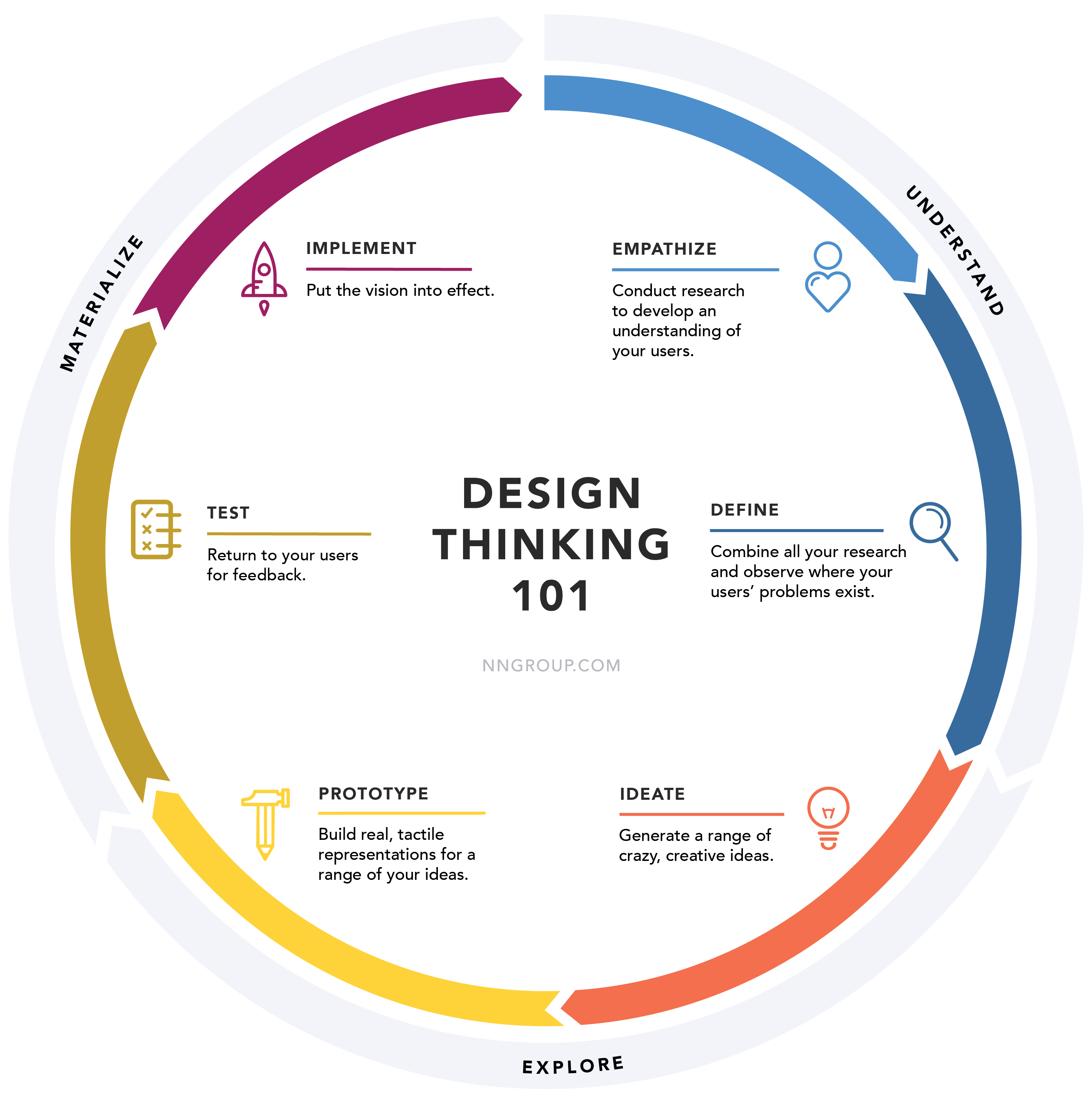
There are 3 phases depicted: understand, explore, and materialize. The understand phase,
comprising empathize and define steps, is the focus of this assignment. You should focus on
well-defined activities that well-defined users are trying to perform.
- describe: describe the activity/activities and the user(s) with sufficient detail to be relatable
- empathize: each member of your group will do this by creating one
or moreempathy mapsfortheeach activitie(s)y - define: identify specific aspects of the current interface that cause problems for the users and explore the roots of those problems. Identify whatever user needs may be unmet
Remember that this phase is still concerned with articulating the problem. No solutions should appear here. That will come later.
Submission
- submit a pdf document (1 per group) on URcourses that includes all three parts (describe, empathize, and define)
- target: 6 - 10 problems or unmet needs (about 2 per group member)
Grading
- on time but the written instructions for the submission were not followed: deduct 10% of the earned grade
- Within 24 hours of the due date and time): deduct 20% of the earned grade
- More than 24 and less than 48 hours late: deduct 40% of the earned grade until the cut-off date, after which no grade can be earned.
- More than 48 and less than 72 hours late: deduct 60% of the earned grade until the cut-off date, after which no grade can be earned.
- More than 72 and less than 96 hours late: deduct 80% of the earned grade until the cut-off date, after which no grade can be earned.
- More than 96 and less than 108 hours late: deduct 90% of the earned grade until the cut-off date, after which no grade can be earned.
- More than 108 hours late: deduct 100% of the earned grade until the cut-off date, after which no grade can be earned.
This assignment is worth 6 marks, according to the following rubric:
Rubric
DePaul Univerity’s Center for Teaching and Learning has a useful resource describing the process of creating rubrics. Your comments about the following rubric are welcome via email
| Criterion and Weight | Exemplary | Sufficient | Developing | Needs Improvement |
|---|---|---|---|---|
| Description of User(s) (0.75) | Clear and compelling | Concrete | Lacks detail | Substantially missing |
| Description of Task(s) (0.75) | Clear and compelling | Concrete | Lacks detail | Substantially missing |
| Empathy Map(s) (2.0) | All quadrants done well by all | Entries in all quadrants | Few entries, lacking detail | Substantially incomplete |
| Problems and Unmet Needs (2.0) | Thoroughly explored and documented (without indicating solutions) | Quite complete | Not enough requirements or detail | Missing requirements and detail |
| Writing (0.5) | Shows a good command of Standard English. No problems for your audience | Demonstrates evidence of correct spelling, grammar, and punctuation. Audience will have little trouble reading your work | Some errors, audience may have some trouble reading your work | Consistently uses incorrect grammar, spelling, and syntax that makes it difficult for others to follow |
Calculator
Critique a Project ()
Critique a Project
This is an INDIVIDUAL assignment.
You have been placed into a “Critique” group, the members of which will receive the submission from a “Project” group (in a message posted here). In order to keep the projects on track, please complete your critique on time.
Review the submission sent to you and provide constructive feedback based on what was requested in the Understand Project assignment.
Share your observations, ideas, and questions that you have for the group. Please remember to be constructive, and specific.
Submission
- submit a pdf document
- target: 1 page for the review and 1-2 pages for the sharing
Grading
- on time but the written instructions for the submission were not followed: deduct 10% of the earned grade
- Within 24 hours of the due date and time): deduct 20% of the earned grade
- More than 24 and less than 48 hours late: deduct 40% of the earned grade until the cut-off date, after which no grade can be earned.
- More than 48 and less than 72 hours late: deduct 60% of the earned grade until the cut-off date, after which no grade can be earned.
- More than 72 and less than 96 hours late: deduct 80% of the earned grade until the cut-off date, after which no grade can be earned.
- More than 96 and less than 108 hours late: deduct 90% of the earned grade until the cut-off date, after which no grade can be earned.
- More than 108 hours late: deduct 100% of the earned grade until the cut-off date, after which no grade can be earned.
This assignment is worth 6 marks, according to the following rubric:
Rubric
DePaul Univerity’s Center for Teaching and Learning has a useful resource describing the process of creating rubrics. Your comments about the following rubric are welcome via email
| Criterion and Weight | Exemplary | Sufficient | Developing | Needs Improvement |
|---|---|---|---|---|
| Review (2.75) | Thoughtful and thorough | Reasonably thorough | Somewhat complete | Substantially incomplete |
| Sharing (2.75) | Thoughtful and thorough | Reasonably thorough | Somewhat complete | Substantially incomplete |
| Writing (0.5) | Shows a good command of Standard English. No problems for your audience | Demonstrates evidence of correct spelling, grammar, and punctuation. Audience will have little trouble reading your work | Some errors, audience may have some trouble reading your work | Consistently uses incorrect grammar, spelling, and syntax that makes it difficult for others to follow |
Calculator
Design ()
Project Design
Based on your understanding, design!
Recall the diagram that illustrated the article about Design Thinking from the Nielsen Norman Group. We are now moving to the explore phase.
The focus now shifts from understanding the problems to proposing solutions for those problems. Using the results from the last project assignment (and considering the feedback that you will receive from your critique group), state the task that the user will perform. If you had many tasks in the last project assignment, please focus at this stage on 1 substantial task that accomplishes a meaningful goal for the user
Then consider how the user will do the task:
- which interface metaphors (see Sections 3.4 and 12.3 in textbook) would be suitable to help users understand the activities
- which interaction type(s) (see Section 3.5 in textbook) would best support the users’ activities
- whether different interface types suggest alternative design insights or options
Choose 2 different metaphors and design an interface for each of the metaphors that you choose. For both interfaces:
- Create a low-fidelity prototype (see Section 12.2 in textbook)
- Write a scenario (see Section 11.5 in textbook) that includes details of the information presented and interaction undertaken
- Analyze your scenario for positive and negative aspects and iterate your low-fidelity prototypes and scenarios to minimize the negative aspects and maximize the positive aspects
Submission
- submit a pdf document (1 per group)
Grading
- on time but the written instructions for the submission were not followed: deduct 10% of the earned grade
- Within 24 hours of the due date and time): deduct 20% of the earned grade
- More than 24 and less than 48 hours late: deduct 40% of the earned grade until the cut-off date, after which no grade can be earned.
- More than 48 and less than 72 hours late: deduct 60% of the earned grade until the cut-off date, after which no grade can be earned.
- More than 72 and less than 96 hours late: deduct 80% of the earned grade until the cut-off date, after which no grade can be earned.
- More than 96 and less than 108 hours late: deduct 90% of the earned grade until the cut-off date, after which no grade can be earned.
- More than 108 hours late: deduct 100% of the earned grade until the cut-off date, after which no grade can be earned.
This assignment is worth 6 marks, according to the following rubric:
Rubric
DePaul Univerity’s Center for Teaching and Learning has a useful resource describing the process of creating rubrics. Your comments about the following rubric are welcome via email
| Criterion and Weight | Exemplary | Sufficient | Developing | Needs Improvement |
|---|---|---|---|---|
| Interface 1 Low-Fidelity Prototype (Sketch) (1.5) | clear | comprehensible | mostly complete | incomplete |
| Interface 1 Scenario (1.0) | thoughtful and thorough | thorough | mostly complete | incomplete |
| Interface 1 Iteration Process Description (0.5) | thoughtful and thorough | thorough | mostly complete | incomplete |
| Interface 2 Low-Fidelity Prototype (Sketch) (1.5) | clear | comprehensible | mostly complete | incomplete |
| Interface 2 Scenario (1.0) | thoughtful and thorough | thorough | mostly complete | incomplete |
| Interface 2 Iteration Process Description (0.5) | thoughtful and thorough | thorough | mostly complete | incomplete |
Calculator
Report as Test Subject ()
Report as Test Subject
This is an INDIVIDUAL assignment.
You have been placed into an “Eval” group. You are to coordinate, as has been discussed in class meetings, with the other members of your “Eval” group so that you will each conduct 1 test of your “A” interface and 1 test of your “B” interface (with 2 different people). In turn, you will be the test subject for 2 others from your “Eval” group. You are to complete this assignment from the perspective of test subject.
- What did you notice or observe about your 2 experiences as test subject?:
- Was there anything different between them?
- Was anything especially easy or hard about shifting between running the tests of your interfaces and being a test subject for someone else?
- Do you have any comments or constructive criticisms for your peers who ran the tests when you were the subject?
Submission
- submit a pdf document
Grading
- on time but the written instructions for the submission were not followed: deduct 10% of the earned grade
- Within 24 hours of the due date and time): deduct 20% of the earned grade
- More than 24 and less than 48 hours late: deduct 40% of the earned grade until the cut-off date, after which no grade can be earned.
- More than 48 and less than 72 hours late: deduct 60% of the earned grade until the cut-off date, after which no grade can be earned.
- More than 72 and less than 96 hours late: deduct 80% of the earned grade until the cut-off date, after which no grade can be earned.
- More than 96 and less than 108 hours late: deduct 90% of the earned grade until the cut-off date, after which no grade can be earned.
- More than 108 hours late: deduct 100% of the earned grade until the cut-off date, after which no grade can be earned.
This assignment is worth 6 marks, according to the following rubric:
Rubric
DePaul Univerity’s Center for Teaching and Learning has a useful resource describing the process of creating rubrics. Your comments about the following rubric are welcome via email
| Criterion and Weight | Exemplary | Sufficient | Developing | Needs Improvement |
|---|---|---|---|---|
| Observations from Both Experiences (2.75) | Thoughtful and thorough | Reasonably thorough | Somewhat complete | Substantially incomplete |
| Comments and Constructive Criticisms (2.75) | Thoughtful and thorough | Reasonably thorough | Somewhat complete | Substantially incomplete |
| Writing (0.5) | Shows a good command of Standard English. No problems for your audience | Demonstrates evidence of correct spelling, grammar, and punctuation. Audience will have little trouble reading your work | Some errors, audience may have some trouble reading your work | Consistently uses incorrect grammar, spelling, and syntax that makes it difficult for others to follow |
Calculator
You Choose (Undergrad) ()
You Choose (Undergrad)
This is an INDIVIDUAL assignment for undergraduate students.
Consider the class themes that we have discussed and will consider. Please see the page of
Topics for a guide.
Write approximately 1000 words (or equivalent) about your chosen topic as an essay or you are welcome to consider other forms of deliverable that are more meaningful to you — such an HTML/JavaScript implementation of some ideas discussed in class (perhaps extending something from https://github.com/dhhepting/dhhepting.github.io).
It must deal with class themes in some way, and your ideas about that connection are important. You might focus your efforts on researching smaller assessment questions (from Topics),
examining the usability of software that you use, writing some code to test an idea, and so forth.
Your submission should include between 2 and 4 external references ( NOT wikipedia).
Submission
- submit a pdf document
Grading
- on time but the written instructions for the submission were not followed: deduct 10% of the earned grade
- Within 24 hours of the due date and time): deduct 20% of the earned grade
- More than 24 and less than 48 hours late: deduct 40% of the earned grade until the cut-off date, after which no grade can be earned.
- More than 48 and less than 72 hours late: deduct 60% of the earned grade until the cut-off date, after which no grade can be earned.
- More than 72 and less than 96 hours late: deduct 80% of the earned grade until the cut-off date, after which no grade can be earned.
- More than 96 and less than 108 hours late: deduct 90% of the earned grade until the cut-off date, after which no grade can be earned.
- More than 108 hours late: deduct 100% of the earned grade until the cut-off date, after which no grade can be earned.
This assignment is worth 12 marks, according to the following rubric:
Rubric
DePaul Univerity’s Center for Teaching and Learning has a useful resource describing the process of creating rubrics. Your comments about the following rubric are welcome via email
| Criterion and Weight | Exemplary | Sufficient | Developing | Needs Improvement |
|---|---|---|---|---|
| Topic (2) | Topic actively engages an important issue related to class | Topic engages an important issue related to class | Topic somewhat engages an important issue related to class | Topic does not engage an important issue related to class |
| Content (6) | Deliverable is used appropriately and imaginatively. Realization of approach is clear and well-formed | Deliverable is used appropriately. Realization of approach is reasonable | Deliverable is used somewhat appropriately. Realization of approach is mostly unclear and not well-formed | Deliverable is not used appropriately. Realization of approach is not clear |
| Presentation (4) | Ambitious and thorough | Reasonably thorough | Somewhat thorough | Not thorough |
Calculator
Research Paper Review (Grad) ()
Research Paper Review (Grad)
This is an INDIVIDUAL assignment for graduate students.
Choose a recent (within the last 3 years) conference paper (with at least 8 pages) that is new to you, from ACM SIGCHI conferences (including CHIPLAY).
Critically read the paper and write a summary of it, according to Fong’s alternative method for reviewing papers:
- What is the purpose of the work?
- How do the authors achieve their purpose?
- Why did they adopt their particular approach?
- Do you think their purpose has been achieved?
- What insights have you gained from reading this work?
Finally, include an explanation of why you chose this paper.
Your summary should be approximately 1000 words.
Submission
- submit a pdf document
Grading
- on time but the written instructions for the submission were not followed: deduct 10% of the earned grade
- Within 24 hours of the due date and time): deduct 20% of the earned grade
- More than 24 and less than 48 hours late: deduct 40% of the earned grade until the cut-off date, after which no grade can be earned.
- More than 48 and less than 72 hours late: deduct 60% of the earned grade until the cut-off date, after which no grade can be earned.
- More than 72 and less than 96 hours late: deduct 80% of the earned grade until the cut-off date, after which no grade can be earned.
- More than 96 and less than 108 hours late: deduct 90% of the earned grade until the cut-off date, after which no grade can be earned.
- More than 108 hours late: deduct 100% of the earned grade until the cut-off date, after which no grade can be earned.
This assignment is worth 12 marks, according to the following rubric:
Rubric
DePaul Univerity’s Center for Teaching and Learning has a useful resource describing the process of creating rubrics. Your comments about the following rubric are welcome via email
| Criterion and Weight | Exemplary | Sufficient | Developing | Needs Improvement |
|---|---|---|---|---|
| What is the purpose of the work? (2.0) | Thoughtful and thorough | Reasonably thorough | Somewhat complete | Substantially incomplete |
| How do the authors achieve their purpose? (2.0) | Thoughtful and thorough | Reasonably thorough | Somewhat complete | Substantially incomplete |
| Why did they adopt their particular approach? (2.0) | Thoughtful and thorough | Reasonably thorough | Somewhat complete | Substantially incomplete |
| Do you think their purpose has been achieved? (2.0) | Thoughtful and thorough | Reasonably thorough | Somewhat complete | Substantially incomplete |
| What insights have you gained from reading this work? (2.0) | Thoughtful and thorough | Reasonably thorough | Somewhat complete | Substantially incomplete |
| Why did you choose this paper? (1.0) | Thoughtful and thorough | Reasonably thorough | Somewhat complete | Substantially incomplete |
| Writing (1.0) | Shows a good command of Standard English. No problems for your audience | Demonstrates evidence of correct spelling, grammar, and punctuation. Audience will have little trouble reading your work | Some errors, audience may have some trouble reading your work | Consistently uses incorrect grammar, spelling, and syntax that makes it difficult for others to follow |
Calculator
Evaluate Low-Fidelity Prototypes ()
Evaluate
Based on your designs, test!
Recall the diagram that illustrated the article about Design Thinking from the Nielsen Norman Group. We are now moving to the materialize phase.
The focus now shifts to testing your low-fidelity prototypes. Each member of your group will conduct 1 test with each of your group’s 2 low-fidelity interface prototypes. The tests will be arranged from within your evaluation (Eval) groups. Each Eval group has 3 members. Use URcourses to coordinate with your Eval group members. For illustrative purposes, consider a group with Bob, Fanhua, and Premla. Each of them will arrange 2 meetings:
- Bob and Fanhua arrange to meet:
- Bob tests his group’s Interface A with Fanhua
- Fanhua tests his group’s Interface B with Bob
- Bob and Premla arrange to meet:
- Bob tests his group’s Interface B with Premla
- Premla tests her group’s Interface A with Bob
- Fanhua and Premla arrange to meet:
- Fanhua tests his group’s Interface A with Premla
- Premla tests her group’s Interface B with Fanhua
IMPORTANT: Your Eval group should not have any other members from your Project group
In your tests, you are asking someone to take on a role as your user and then complete the task for which you are redesigning the interface. Explain the task and ask your participant to perform the task, without giving instructions about how to do it. This information will be recorded in a script, that all group members will use to run their tests. Writing, and testing, the script is a group effort. Once you start testing with your participants, do not make any changes to your script.
You may find the downloads related to the ZipCar website test useful
During your tests, you will collect both quantitative and qualitative data. You will also have notes that you take during the test.
You should submit all of your raw data and submit a summary of how it was collected: by whom, from whom, when, and where. Each of your group members will collect data from 1 test of your Interface A and 1 test of your Interface B. Both tests will use the same script and other materials.
Provide an analysis of your data. Did the data that you collected from your participants reveal any agreement or disagreement about your interface designs? Were the results surprising in any way?
Submission
- submit a pdf document (1 per group)
Grading
- on time but the written instructions for the submission were not followed: deduct 10% of the earned grade
- Within 24 hours of the due date and time): deduct 20% of the earned grade
- More than 24 and less than 48 hours late: deduct 40% of the earned grade until the cut-off date, after which no grade can be earned.
- More than 48 and less than 72 hours late: deduct 60% of the earned grade until the cut-off date, after which no grade can be earned.
- More than 72 and less than 96 hours late: deduct 80% of the earned grade until the cut-off date, after which no grade can be earned.
- More than 96 and less than 108 hours late: deduct 90% of the earned grade until the cut-off date, after which no grade can be earned.
- More than 108 hours late: deduct 100% of the earned grade until the cut-off date, after which no grade can be earned.
This assignment is worth 6 marks, according to the following rubric:
Rubric
DePaul Univerity’s Center for Teaching and Learning has a useful resource describing the process of creating rubrics. Your comments about the following rubric are welcome via email
| Criterion and Weight | Exemplary | Sufficient | Developing | Needs Improvement |
|---|---|---|---|---|
| Script and Materials (2.0) | ||||
| Qualitative Data and Notes from Test Sessions (1.5) | ||||
| Quantitative Data (1.5) | ||||
| Analysis and Summary of Data (1.0) |
Calculator
Video Presentation ()
Project Presentation
Create a 5-10 minute video to present your project.
- Identify your project and your opportunity for redesign
- Discuss your 2 low-fidelity designs (and metaphors)
- Describe what you learned from your evaluations
- Discuss how your high-fidelity prototype will incorporate what you have learned
Although it would be preferable to have all group members involved in creating the presentation, this is not required.
You may choose the privacy setting for your youtube video (public, unlisted, and private). If you choose private, please ensure that the instructor and marker are granted access.
Submission
- submit a link to your video on youtube (1 per group) using URcourses
Grading
- on time but the written instructions for the submission were not followed: deduct 10% of the earned grade
- Within 24 hours of the due date and time): deduct 20% of the earned grade
- More than 24 and less than 48 hours late: deduct 40% of the earned grade until the cut-off date, after which no grade can be earned.
- More than 48 and less than 72 hours late: deduct 60% of the earned grade until the cut-off date, after which no grade can be earned.
- More than 72 and less than 96 hours late: deduct 80% of the earned grade until the cut-off date, after which no grade can be earned.
- More than 96 and less than 108 hours late: deduct 90% of the earned grade until the cut-off date, after which no grade can be earned.
- More than 108 hours late: deduct 100% of the earned grade until the cut-off date, after which no grade can be earned.
This assignment is worth 3 marks, according to the following rubric:
Rubric
DePaul Univerity’s Center for Teaching and Learning has a useful resource describing the process of creating rubrics. Your comments about the following rubric are welcome via email
| Criterion and Weight | Exemplary | Sufficient | Developing | Needs Improvement |
|---|---|---|---|---|
| Identify Project and Opportunity for Redesign (0.5) | ||||
| Discuss your 2 lo-fi designs (and metaphors) (1.0) | ||||
| Describe what you learned from your evaluations (1.0) | ||||
| Discuss how your hi-fi prototype will incorporate what you have learned (0.5) |
Calculator
High Fidelity ()
High Fidelity Finish
Recall the diagram that illustrated the article about Design Thinking from the Nielsen Norman Group. We are in the materialize phase.
Based on your experience with your project and your testing of your low-fidelity prototypes, create a single high-fidelity design of your interface that combines the best features from your two low-fidelity prototypes. This high-fidelity prototype should be somehow (using your choice of tool) executable on a computer and create an interactive simulation of your interface to perform only your task (and NOT all functionality). You are not writing code for the application per se, rather you are simulating the operation of the software or website for which you are redesigning the interface.
There are 2 parts to this assignment:
- present the choices you made, along with your rationale, in deciding on the interface you designed following your low-fidelity prototypes A and B.
- provide the means for the instructor and marker to view and interact with your high-fidelity prototype, or a demonstration of your simulation with a video as a fallback. Include directions for viewing your work in the document that describes your design choices.
Submission
- submit a pdf document (1 per group) on URcourses that deals with both parts of the assignment
Grading
- on time but the written instructions for the submission were not followed: deduct 10% of the earned grade
- Within 24 hours of the due date and time): deduct 20% of the earned grade
- More than 24 and less than 48 hours late: deduct 40% of the earned grade until the cut-off date, after which no grade can be earned.
- More than 48 and less than 72 hours late: deduct 60% of the earned grade until the cut-off date, after which no grade can be earned.
- More than 72 and less than 96 hours late: deduct 80% of the earned grade until the cut-off date, after which no grade can be earned.
- More than 96 and less than 108 hours late: deduct 90% of the earned grade until the cut-off date, after which no grade can be earned.
- More than 108 hours late: deduct 100% of the earned grade until the cut-off date, after which no grade can be earned.
This assignment is worth 6 marks, according to the following rubric:
Rubric
DePaul Univerity’s Center for Teaching and Learning has a useful resource describing the process of creating rubrics. Your comments about the following rubric are welcome via email
| Criterion and Weight | Exemplary | Sufficient | Developing | Needs Improvement |
|---|---|---|---|---|
| Explanation of and rationale for design choices made in the single hi-fi prototype (3) | ||||
| Demonstration of interactive simulation of hi-fi design simulation (3) |
Calculator
Exams
Previous exams
- 201410 Midterm
- 201030 Final
- 202230 Final
- 202230 Midterm
- 202030 Midterm
- 201930 Final
- 201930 Midterm
- 201830 Final
- 201830 Midterm
- 201730 Final
- 201730 Midterm
- 201630 Final
- 201630 Midterm